
Civil Protection Order Portal Design
Overview
National Best-Practice Guidance for Domestic Violence Survivor-Facing Systems
The Challenge
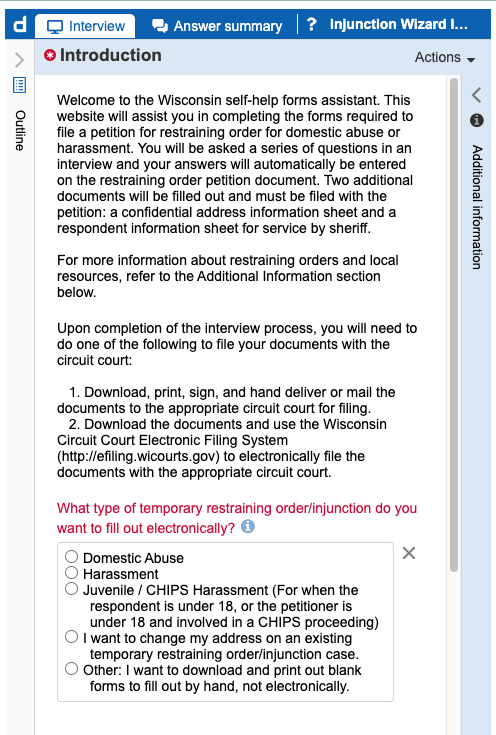
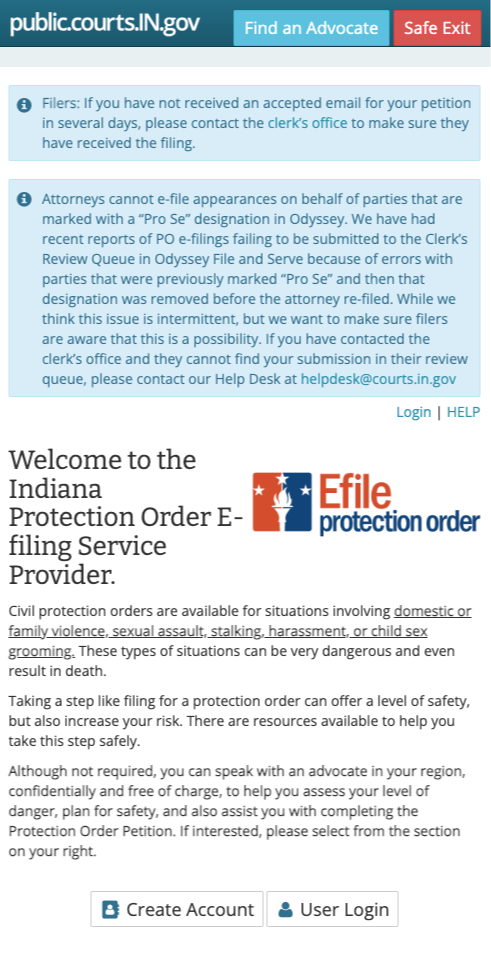
Civil protection order (CPO) portals are among the most consequential government services a survivor of domestic violence will ever use, yet there is no national guidance for how these portals should be designed to serve survivors safely and effectively.
Across the country, portals built for legal professionals are being used by self-represented survivors under conditions of acute stress, fear, and danger. I partnered with the National Center for State Courts to learn how we can improve CPO portal design.
My role
I led Innovation for Justice's subrecipient role on a $1.4 million Department of Justice grant awarded to the National Center for State Courts. Over multiple years, I provided technical assistance to state courts undertaking portal design and redesign, and I led the development of national best-practice guidance for survivor-facing civil protection order portal design.Conducted UX discovery and evaluation research across multiple state jurisdictions, including Wisconsin and Indiana, using usability testing, heuristic evaluation, cognitive walkthroughs, and system actor interviews.
Produced UX Discovery and UX Evaluation reports for each jurisdiction documenting current-state experience, systemic gaps, and prioritized recommendations.
Facilitated co-design workshops court administrators, clerks, advocates, and technologists to align on design directions and build implementation capacity.
Applied a trauma-informed ethical tech design framework at every stage, evaluating design decisions against criteria of safety, trust, dignity, plain language, mobile design, usability, and accessibility.
Presented findings and guidance at the ABA Equal Justice Conference and the Legal Services Corporation Innovations in Technology Conference.
Impact
What we learned
Survivors navigating protection order portals face compounding barriers: legal language written for attorneys, interface designs that assume linear processes, and systems that force disclosure of sensitive location information without explanation. The most impactful design interventions were often the simplest: plain language rewrites, progressive disclosure of sensitive fields, and clear explanation of what happens next. Achieving even those changes required sustained relationship-building with court administrators navigating their own institutional constraints.
Key artifacts
UX Discovery Report: A New Wisconsin Restraining Order Portal (2026).
UX Evaluation Report: Indiana Civil Protection Order Portal (2025).
National best-practice guidance for civil protection order portal design with workshop facilitation guides and co-design templates (in development)
Learn more: innovation4justice.org/portal-design